.avif)
A New Killer in Gaza… Death Without a Chance to Say Goodbye
After a period of relative calm in Israeli airstrikes on Gaza, a new killer has emerged in the besieged enclave—one that does not even allow its people the chance to bid farewell to their loved ones.
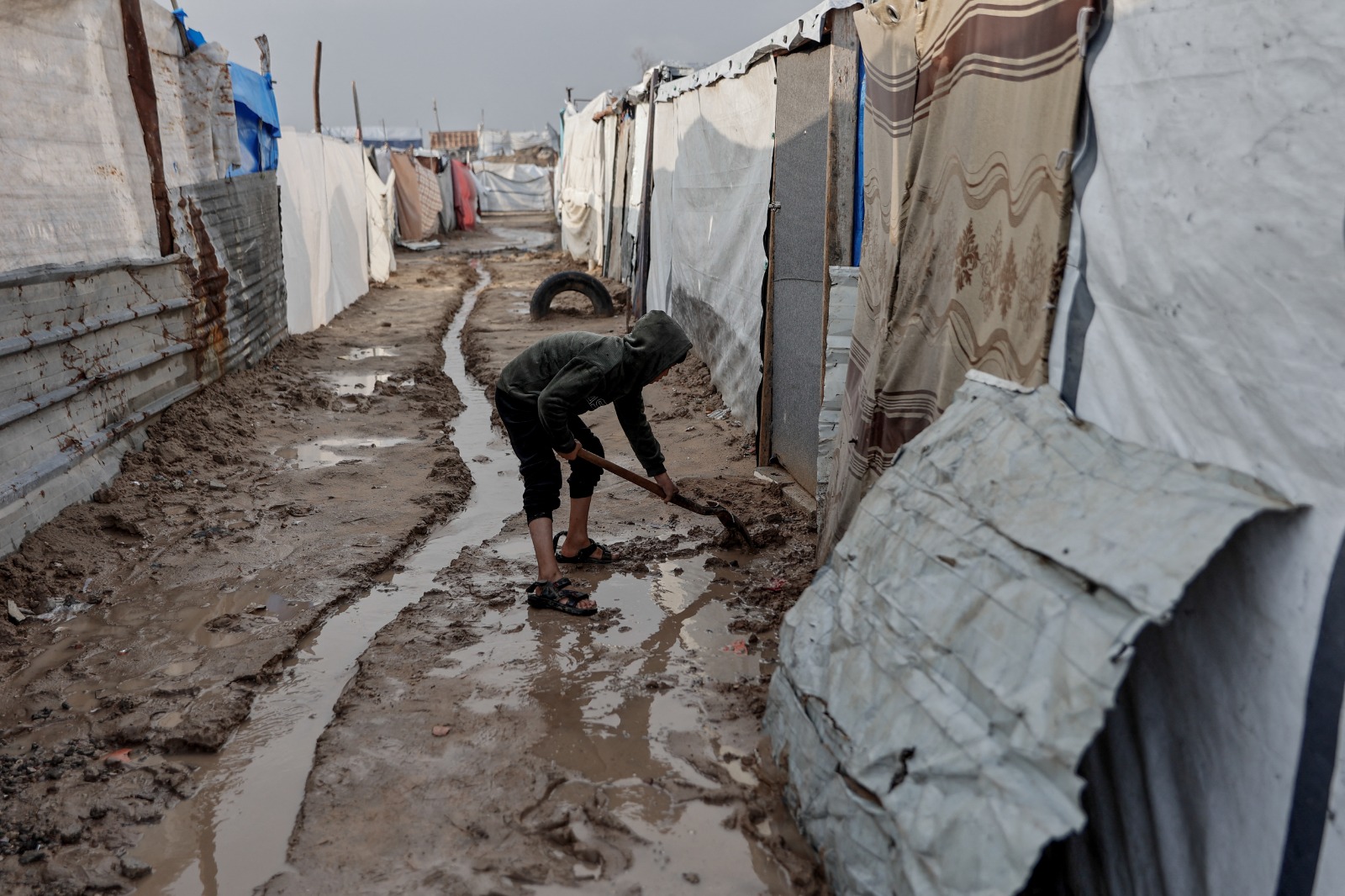
Wearing light cotton shirts and jackets and open summer shoes, young Palestinian men in a displacement camp in Gaza City’s Zeitoun neighborhood ventured out carrying shovels, trying to drain the torrential rainwater that flooded their tents.
On Wednesday evening, a storm swept across the Gaza Strip and the Palestinian territories in general, inundating displacement camps and destroyed homes, further compounding the suffering of residents—most of whom have been displaced at least once during a devastating war that has lasted for more than two years.
The war’s destruction—leaving most buildings in Gaza either razed or severely and partially damaged—has led to the spread of thousands of tents, many of them erected atop rubble cleared after a truce came into effect on October 10.
According to a United Nations report, 850,000 people living in 761 displacement camps and sites are at high risk of flooding.
In low-lying areas such as Al-Zawayda camp in central Gaza, where tents have proliferated, floodwaters formed small pools.
Soad Muslim, displaced from Beit Lahia, spoke from inside her tent in Al-Zawayda: “Last night was a black night for us and our children because of the cold and the rain. We couldn’t even cover a child; the blankets were soaked with water. We don’t know where to go.”
Speaking emotionally over the sound of water flowing outside her plastic tent, she added: “Give us proper tents, tarpaulins to cover our children, clothes for our children. They walk barefoot and can’t find shoes. Until when? This is injustice.”
Because of Israel’s blockade of the Strip and its control over the entry of aid—which the United Nations says is insufficient—impoverished residents are unable to cope with the cold weather.
Shorouq Muslim, also displaced from Beit Lahia, described the situation as “very difficult” as she held a young girl dressed in red on her lap. “We don’t know what to do. We can’t go out to light a fire—there is no firewood, and we have no gas,” she said.
Since the outbreak of the war, Gaza’s population has suffered acute shortages of gas, firewood, food, medicine, and other basic necessities, with most residents dependent on aid arriving from abroad.
According to Mahmoud Bassal, spokesperson for Gaza’s Civil Defense, deaths caused by extreme cold have been recorded. Bassal said the effects of the low-pressure system are “extremely dangerous for citizens,” especially given the collapse of infrastructure across the Strip.
In a statement on Thursday, the Civil Defense said its teams responded to partial collapses in three homes caused by heavy rainfall.
The agency warned residents against returning to homes that have become unsafe and at risk of collapse due to airstrikes during the war, a situation worsened by the storm.
Bassal stressed the urgent need to bring in ready-to-live mobile housing units.
“Tents are completely unacceptable,” he said. “What must enter now are caravans equipped with solar power, two rooms, a bathroom, and the tools citizens need.”
On Friday, Gaza’s Civil Defense announced that at least 16 people had died over the past 24 hours, including three children who died from exposure to cold, as a winter storm battered the devastated Palestinian enclave.
Al-Shifa Hospital in Gaza City confirmed the death of nine-year-old Hadeel Al-Masri and infant Taim Al-Khawaja, who was said to be only a few months old.
Nasser Hospital in Khan Younis also confirmed on Thursday that eight-month-old infant Rahaf Abu Jazar died from cold exposure in the Al-Mawasi camp.
Two bodies were recovered from under the rubble of a home in Gaza City’s Sheikh Radwan neighborhood, while other bodies remain trapped beneath the debris.
Umm Mohammed Joudeh said, “The mattress has been soaked since this morning, and the children slept on wet bedding last night. We have no dry clothes to wear.”
Jonathan Crickx, spokesperson for UNICEF, currently in Gaza, said nighttime temperatures could drop to around eight or nine degrees Celsius.
“The rain is heavy, and these families are living in tents battered by the wind, barely protected by a piece of plastic sheeting,” he said.
Samer Morsi, a 22-year-old displaced man living in Deir al-Balah in central Gaza, said he “spent the night holding onto the tent pole so it wouldn’t be blown away by the strong winds. We don’t know how to deal with these harsh conditions. We are human beings with feelings—we are not made of stone.”